
One of the most frequent questions we get at IRDT, in project writing workshops for student organisations or simply by e-mail, goes something like this: “We have a good idea for young people. Where do we submit it?” The right answer is almost always another question: what do you actually want to happen? Funding programmes are not interchangeable, and the most common mistake is to force a good idea into the wrong programme just because that one had an open call this month. The article below is a simplified map, drawn from more than ten years of projects, of the main options and the criteria we would use to choose between them.
The first question is about the scale of the idea: do you want to work with twenty young people from your neighbourhood or with young people from five countries? The second is about duration: is it an activity of a few days, a process of a few months or a change that needs two or three years? The third is about the organisation’s capacity: do you have someone who can handle complex reporting, co-financing and advance payments, or are you a team of volunteers with limited time? And the fourth, often ignored, is about what remains after the project: a competence for participants, a product, a relationship, a change in local policy. The answers to these questions rule out half of the options on their own.
European programmes managed directly for youth
For youth organisations, Erasmus+ is the best-known programme and the one we have most experience with, with thirteen projects coordinated since 2016. Its youth strand funds youth exchanges, that is, meetings of a few days between groups from several countries; training courses for youth workers, the people who work directly with young people outside school; and larger partnerships of one or two years in which several organisations develop methods or materials together. Erasmus+ fits when the idea has a real international dimension, when learning is at the centre and when you have, or can build, trusted partners in other countries. It does not fit when what you really want is a local activity and you add a foreign partner only to tick the requirement.
The European Solidarity Corps funds volunteering, individual or in teams, and solidarity projects: local initiatives by groups of at least five young people, with small budgets and relatively little bureaucracy. In our view it is the most underestimated option for an informal group of young people with a concrete idea for their community. The CERV programme, for citizens, equality, rights and values, is something else: it funds projects on democratic participation, fundamental rights, gender equality or European remembrance. It fits when your idea is essentially about citizenship and values rather than about training young people as such, and it usually requires stronger consortia and larger budgets.
European funds for education and employment
The second large category is the operational programmes financed from the European funds managed by Romania, especially those for education and employment. The logic here is different: we are no longer talking about learning through mobility but about structured interventions with numerical targets, for NEET young people (not in education, employment or training), for pupils at risk of dropping out, for young people who need a qualification or support to find a job. Budgets are much larger, duration is usually two or three years and the administrative requirements are to match. These programmes suit organisations with proven implementation capacity, often in partnership with universities, authorities or training providers. They do not suit a first project experience, nor ideas that cannot be translated into clear indicators.
The closest level, and often the most neglected, is the grants awarded by city halls and county councils under Romanian Law 350/2005 for youth, cultural, sports or social activities. Amounts are modest, procedures are simpler and competition is usually between organisations from the same community. The main advantage is that they let you test an idea on a small scale, build the relationship with the local authority and achieve visible results within a few months. Added to these are grants through county youth foundations, such as FITT in Timiș, of which we are a member, and calls from companies or private foundations.
A few practical criteria
If we had to sum up in a short list what we ask ourselves before choosing, it would look roughly like this:
- Does the idea need the international dimension, or are we adding it artificially?
- Do we have the capacity to manage advances, co-financing and reporting for the whole duration of the project?
- Is the main result the participants’ learning, a change in the community or an employment indicator?
- Can we start smaller, locally, and grow later towards a European programme?
The last point is perhaps the most important advice we can give. Many of our European projects started from local activities, a hackathon, a workshop, a meeting with student organisations, that showed us what works and what does not. The opposite path, from a large European project to a real local presence, is much harder. If you have an idea and do not know where it fits, write to us. Sometimes the most useful thing we can do is not to help you write the application, but to help you choose which call is actually worth writing it for.
Similar articles
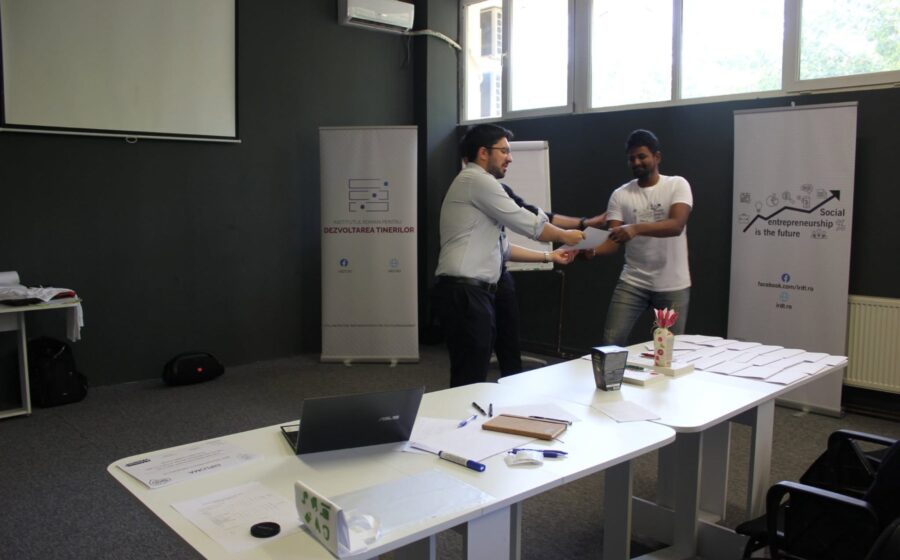
Universities, NGOs and companies: what a local partnership that delivers for young people looks like
Partnerships between universities, NGOs and companies are often invoked and rarely functional. What we have learned about the ones that actually deliver.
Read
Research with and about young people: how an NGO joins a Horizon Europe consortium
Horizon Europe is not only for universities. What role youth organisations can play in research projects on society and democracy.
Read
Advanced digital skills and young people: what the Digital Europe Programme offers and where non-formal education fits
The Digital Europe Programme invests in advanced digital skills. Where it meets non-formal education and young people in western Romania.
Read