
Horizon Europe is the European Union’s framework programme for research and innovation, the largest instrument of its kind in the world. When we hear the name, we think of laboratories, large universities and projects with dozens of partners. We think less often that a youth organisation from a city the size of Timișoara could have a place in it. And yet part of the programme is devoted to exactly the questions we deal with every day: how young people take part in democracy, how work and education are changing, what inclusion means in an increasingly diverse society, how culture is passed on between generations. For questions like these, research needs people who work on the ground, and we are among them.
The programme is built on three pillars, and the second one, devoted to global challenges and industrial competitiveness, is divided into thematic clusters. Cluster 2, “Culture, Creativity and Inclusive Society”, broadly covers three directions: democracy and governance; cultural heritage and the creative industries; and social and economic transformations, including education, employment, inequalities and migration. Alongside the clusters, Horizon Europe has missions, that is, ambitious goals on topics such as adaptation to climate change or climate-neutral cities, in which the involvement of citizens, including young people, is an important component. Calls are published on the Funding & Tenders portal, in multi-annual work programmes, and the details of each call must be read carefully there.
What a research consortium looks for in an NGO
A Horizon Europe project in Cluster 2 is usually coordinated by a university or a research institute and brings together partners from several countries, with different roles. Researchers design the study, collect and analyse data and publish results. But research about young people has a well-known problem: young people, especially those from backgrounds with fewer opportunities, are hard to involve in studies, and the results rarely make their way back to them or to those who work with them. This is where civil society organisations come in. A youth NGO can open access to hard-to-reach groups, co-design research instruments so that they make sense to participants, test solutions proposed by researchers in practice and translate the results into recommendations, training or concrete activities.
There is a term for this kind of cooperation: participatory research, that is, research in which the people being studied are not just subjects but partners in framing the questions and interpreting the answers. The programme explicitly encourages the involvement of citizens and civil society, and in many Cluster 2 calls it is expected, not merely tolerated. For us this is good news: the experience from projects such as Participation is Power or Advocacy to Go, where we worked with youth workers, the professionals and volunteers who accompany young people outside school, on participation and advocacy, is exactly the kind of experience a consortium looks for when it needs a partner who understands practice.
What an NGO should know before joining
We do not want to make things look easier than they are. A Horizon Europe project is demanding. The organisation must be registered on the Funding & Tenders portal and go through a validation of its legal and financial capacity. The budget is managed under strict rules, reporting is detailed and the expectations on the quality of results are high. The role of a small partner is usually clearly bounded: a few work packages or tasks related to involving target groups, testing instruments or dissemination. It is important that this role is realistic, with dedicated staff, and that the organisation does not accept responsibilities it cannot deliver just to be part of the consortium.
The hardest part for an organisation like ours is not implementation but getting in. Consortia usually form around networks of researchers who already know each other, and the invitation to a field partner often comes late and with a role already defined. The best route we see is to build relationships before any call: with the universities in Timișoara, which have research groups in the social and educational sciences, and with the European partners we have already worked with, some of whom have links to academia in their own countries. An NGO becomes a credible research partner when it can show that it has already worked with researchers, even on a small scale, and that it knows what rigour means.
What we aim for is modest and, we hope, realistic: to start documenting what we do more systematically, to look for cooperation with local researchers interested in young people and to join the networks in which Cluster 2 consortia are formed. We will not coordinate a Horizon Europe project in the near future and we do not claim to. But we believe that young people in western Romania deserve to be part of European research about them, and someone has to open that door for them.
Similar articles
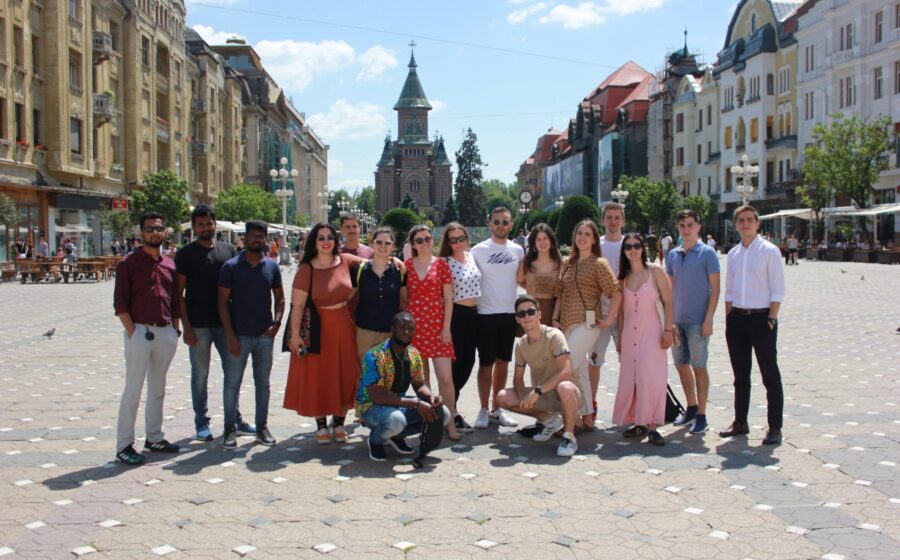
Democracy, European values and young people: what the CERV programme funds and why it matters for a city like Timișoara
The CERV programme funds projects on democracy, rights and civic participation. What it means for a youth NGO in Timișoara.
Read
Advanced digital skills and young people: what the Digital Europe Programme offers and where non-formal education fits
The Digital Europe Programme invests in advanced digital skills. Where it meets non-formal education and young people in western Romania.
Read
Universities, NGOs and companies: what a local partnership that delivers for young people looks like
Partnerships between universities, NGOs and companies are often invoked and rarely functional. What we have learned about the ones that actually deliver.
Read